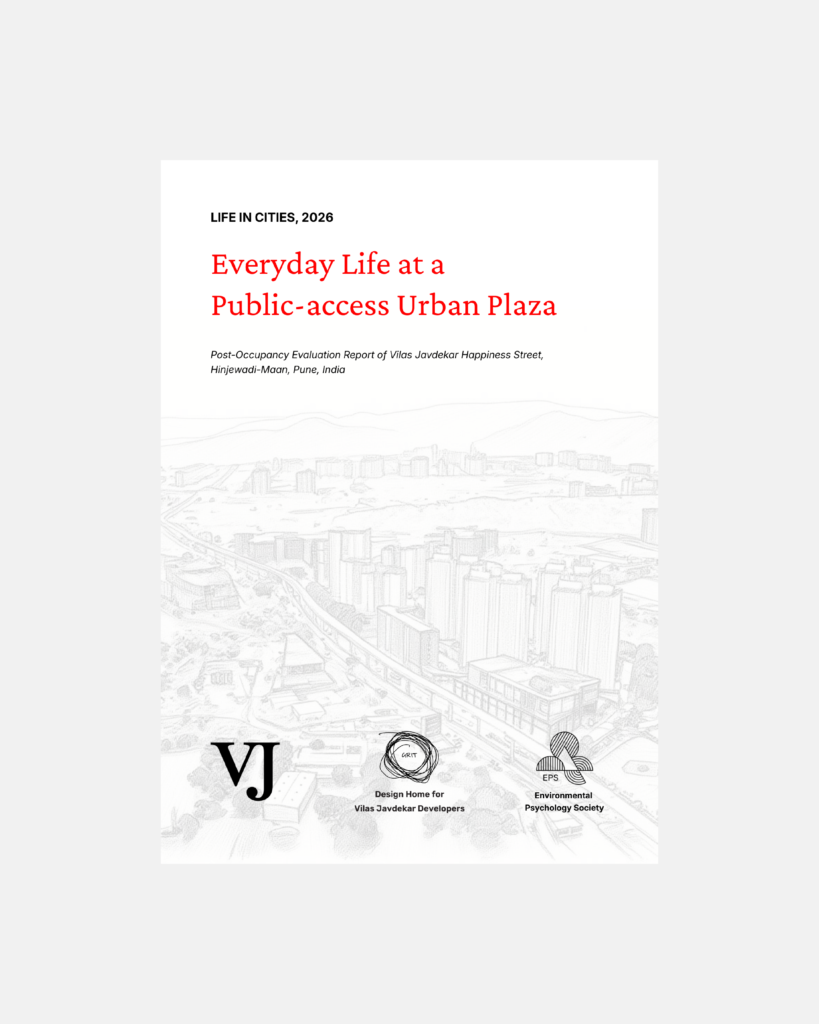
Everyday Life at a Public-access Urban Plaza
This study evaluates the real-world performance of a public-access urban plaza in India, examining how people use, adapt, and experience the space beyond its original design intent. Grounded in the theory of affordances and six months of on-site observation, the research documents activities ranging from seating and socialising to play, work, dining, and transit.
The findings position post-occupancy evaluation as a vital feedback tool for designers and developers. The project offers practical insights for creating more walkable, participatory, and socially responsive urban environments that strengthen long-term city habitability.

Comma: A Look at Touch Through Seating
This journal essay examines a uniquely designed comma-shaped seating element, or “Commas,” to explore how form influences touch, privacy, and social connection in public space. Through a post-occupancy evaluation using covert observations, the study analyses how inner and outer curves afford both solitary retreat and shared intimacy.
The findings reveal how subtle design gestures can support overlooked urban experiences such as quiet pause, companionship, and informal use by diverse users including women and free-ranging dogs. The essay argues for seating designs that balance personal and collective space, enriching everyday life in public environments.

This entry is licensed under a Creative Commons Attribution-NonCommercial-ShareAlike 4.0 International license.

